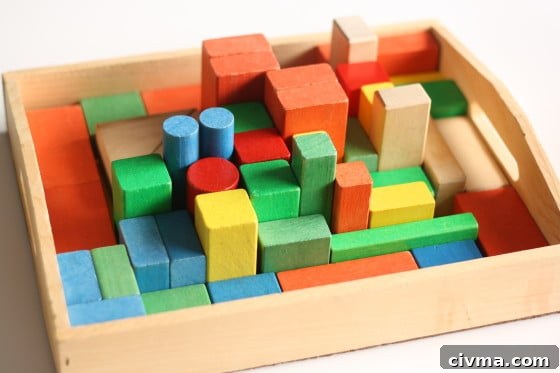
Turn wooden building blocks and a simple tray into a hands-on puzzle challenge that encourages preschoolers to think, plan, build, and problem-solve through play.
Homemade puzzles are some of the easiest and most engaging activities to prepare for toddlers and preschoolers. They do not need to be complicated, expensive, or made with special materials. In fact, some of the best early learning activities come from everyday items already found in the playroom. This homemade block challenge puzzle uses a wooden tray and a collection of building blocks to create a simple but surprisingly thoughtful activity for young children.
The idea came together while gathering a tray of blocks for the children to play with. Once the blocks were sitting in the tray, it became clear that arranging them neatly inside the space could be turned into a fun preschool puzzle activity. The challenge is to fit the blocks into the tray so they fill the available space as completely as possible. It looks simple at first, but it quickly becomes a meaningful exercise in spatial awareness, fine motor control, patience, and creative thinking.
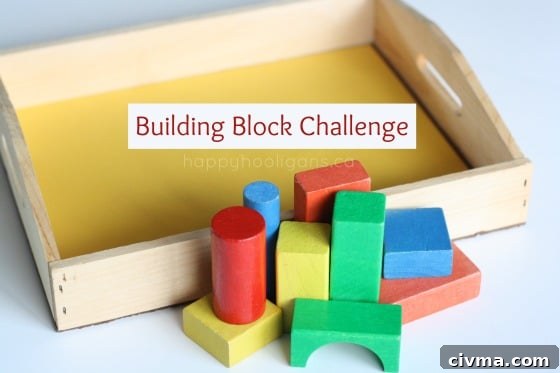
Homemade Puzzle Challenge with Building Blocks
Supplies:
- wooden tray
- building blocks
To set up this homemade building block puzzle, provide your child with a wooden tray, a shallow box, or a sturdy box lid. Add a generous pile of wooden building blocks in different shapes and sizes. The goal is to fill the tray with the blocks, arranging them so there is little or no empty space left.
This preschool block activity is wonderfully open-ended. Children can try different combinations, rotate pieces, stack blocks flat, and experiment with where each shape fits best. Some blocks may seem as though they belong in one spot, only for the child to discover that moving them creates more room for another piece. That trial-and-error process is what makes the activity so valuable.
For younger children, keep the puzzle simple. Offer a smaller container and fewer blocks so the task feels inviting rather than frustrating. A small box with just a handful of wooden blocks can still provide plenty of practice with matching, arranging, and problem-solving. Older preschoolers and school-age children may enjoy a larger tray with more pieces, especially if they are challenged to fill every corner.
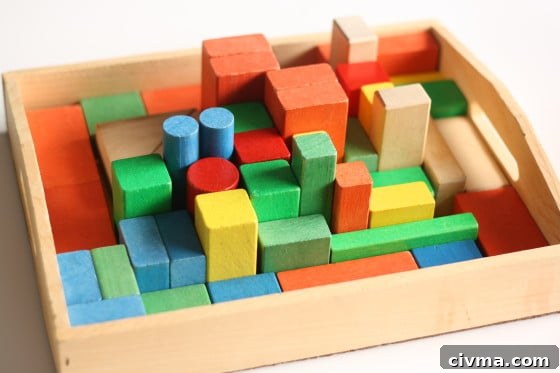
This activity also encourages children to slow down and focus. Unlike free building, where blocks can be stacked in any direction, this puzzle asks children to work within a defined space. That boundary gives the activity structure while still leaving room for creativity. Children may discover patterns, compare block lengths, or begin to understand how shapes work together to fill an area.
Alternative to using a wooden tray – use the floor!
If you do not have a wooden tray, shallow box, or box lid available, you can create a puzzle frame directly on the floor. Use painter’s tape to make a square or rectangle, then invite your child to fill the taped shape with building blocks. This floor version works well when children want more space or when you are using larger blocks.
You can make the taped frame small for beginners or increase the size for children who are ready for a bigger challenge. The same idea applies: children arrange the blocks inside the boundary and try to fill the shape as completely as they can. Because painter’s tape is easy to remove, you can change the size and shape of the puzzle whenever you like.
Before offering this block puzzle challenge to the children, it can be helpful to try it yourself. Filling a tray completely with blocks may take more time than expected, especially if the blocks are different sizes. Finding the right arrangement can be surprisingly satisfying, and it gives you a better sense of how challenging the activity may be for your child.
One way to present the activity is to fill the tray first, then remove several blocks and ask the children if they can fit them back into the empty spaces. Younger preschoolers may not fully understand the puzzle concept right away, but they can still enjoy moving the blocks, testing different spots, and rearranging the pieces. Even if they do not complete the puzzle, they are still practicing important early learning skills through play.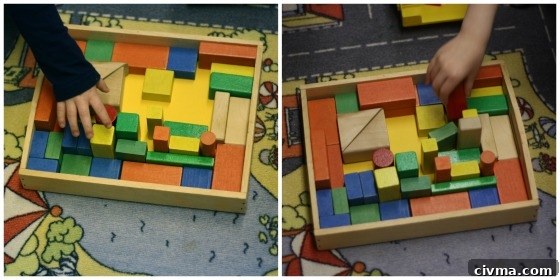
Of course, children may decide to use the blocks in their own way, and that is part of the fun. After exploring the tray puzzle, they might take all the blocks out and use them to build a city, a road, a tower, or a pretend play scene. This kind of flexible activity allows children to move naturally between problem-solving and imaginative play.
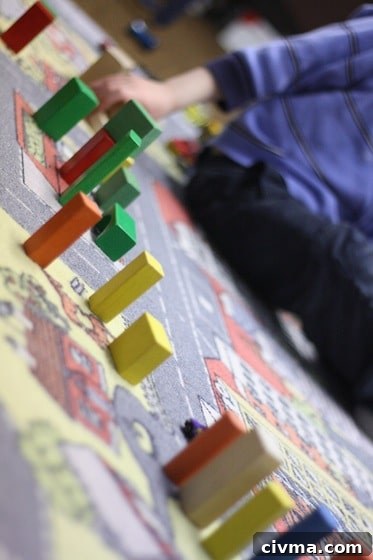 Even if the puzzle is too advanced for some younger children, it is still worth introducing. They may enjoy the sensory feel of the wooden blocks, the sound of the pieces fitting into the tray, and the freedom to explore different arrangements. For older children, the same activity can become a real building challenge that requires planning, concentration, and persistence.
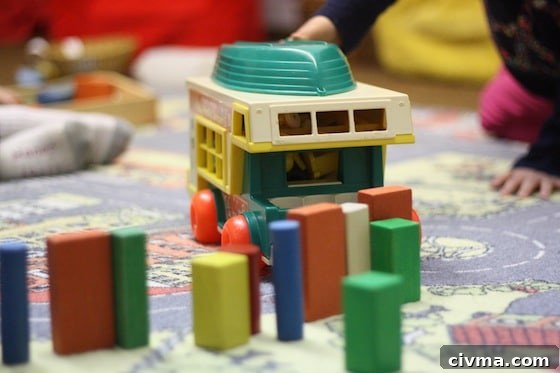
A homemade block puzzle is a simple, low-prep activity that turns ordinary wooden blocks into a playful learning challenge. It supports spatial reasoning, fine motor skills, hand-eye coordination, and problem-solving while giving preschoolers plenty of room to experiment and create.
More easy block and building activities for preschoolers:
Stacking and Spreading with Shaving Cream and Foam Blocks
Frozen Fractals – Building with Ice Blocks
Construction Activity with Styrofoam