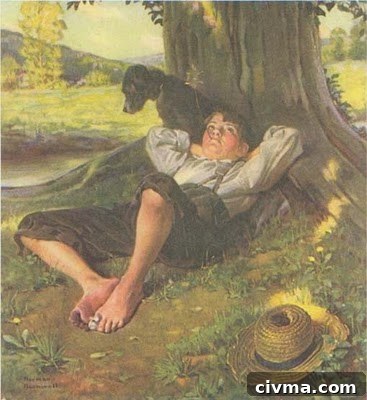
THE BAREFOOT BOY
By JOHN GREENLEAF WHITTIER
“The Barefoot Boy” by John Greenleaf Whittier is a warm and nostalgic celebration of childhood, freedom, nature, and simple joy. The poem blesses a sun-browned boy who runs through the countryside with rolled-up trousers, a cheerful whistle, and the easy happiness that belongs to youth. His face is bright with sunshine, his lips are stained by strawberries, and his torn hat only adds to his carefree charm. To the speaker, this barefoot child is richer than any wealthy traveler who may pass by in comfort. The boy owns something money cannot purchase: open skies, fresh air, lively senses, and a heart filled with natural delight. Looking at him, the speaker remembers his own childhood and offers a heartfelt blessing to every barefoot boy who lives close to the earth.
The poem presents boyhood as a time of painless play, restful sleep, good health, and a kind of wisdom that does not come from classrooms. The barefoot boy learns directly from nature. He knows where the wild bees fly in the morning, where flowers bloom, and where birds build their nests. He observes the tortoise carrying its shell, the woodchuck digging its burrow, and the mole sinking into the ground. He watches robins feed their young and sees how the oriole hangs its nest. He knows where the whitest lilies grow, where the freshest berries ripen, where vines trail along the ground, and where clusters of wild grapes shine in the woods. Even insects become teachers: the black wasp builds with clay, and the hornet becomes an architect. Without books or formal lessons, the boy walks hand in hand with nature, asking questions and receiving answers from the living world around him.
Whittier’s poem also remembers the richness of a childhood summer. June seems to hold many years of discovery within a single month. To a child, every field, brook, tree, bird, and berry can feel like part of a personal kingdom. The speaker recalls feeling wealthy in flowers, trees, hummingbirds, honeybees, squirrels, moles, blackberries, streams, ponds, walnut hills, and orchard apples. The brook seems to laugh for his pleasure by day and night, whispering near the garden wall and speaking from one waterfall to another. The pickerel pond belongs to him, the wooded slopes belong to him, and the orchard seems to offer fruit as precious as treasure. As his world expands, his sense of wonder expands with it. Everything he sees appears designed for his delight, like a marvelous toy made especially for a barefoot boy.
The simple pleasures of childhood are described as more satisfying than any feast. A bowl of milk and bread, eaten with a pewter spoon from a wooden bowl on a rough doorstep, becomes a royal meal. Above the boy, the evening sky spreads like a grand tent, ribbed with clouds, draped in purple, and edged with gold. The sounds of frogs become an orchestra, and fireflies light the scene like tiny lamps. In this humble setting, the child feels like a monarch. There is no need for luxury, because imagination, nature, and contentment transform ordinary moments into scenes of wonder and celebration.
In the final movement of “The Barefoot Boy,” the speaker encourages the child to live cheerfully and laugh while boyhood lasts. The paths may be stony, and the cut fields may be sharp with stubble, but every morning brings fresh dew to the boy’s feet, and every evening brings a cool wind to soothe them. Yet the poem also recognizes that childhood freedom does not last forever. Too soon, those bare feet will be covered by shoes and shaped by adult expectations. They will leave the open ground and enter the world of work, duty, pride, and struggle. The boy who once ran freely across fields may one day walk the hard paths of labor and responsibility. The speaker hopes those feet will never step into wrongdoing or sink into the dangerous sands of sin. Above all, he wishes the child could understand his happiness before it passes.
John Greenleaf Whittier’s “The Barefoot Boy” remains memorable because it honors the beauty of ordinary childhood. It is not only a poem about a child without shoes; it is a poem about innocence, discovery, and the deep connection between a young mind and the natural world. Through vivid images of berries, brooks, birds, insects, sunsets, and summer fields, Whittier reminds readers that some of life’s greatest riches are found in simple experiences. The barefoot boy may have little in material possessions, but he has freedom, curiosity, health, laughter, and a world alive with meaning.